Friday, March 27, 2015

Confluence

Sorry for the gap, fearless readers.  Life, being what it is, has sidelined me for much too long from putting thoughts to pixels and keeping you brave few entertained (and potentially edified).  Fear not, my reading and learning continues apace and the writing will resume soon enough (providing fuel for more regular postings).  Let us begin. 

Medieval knights were stressed out
http://universitypost.dk/article/medieval-knights-were-stressed-out

I must admit that the Christmas gift from my brother is the gift that keeps on giving.  The Hundred Years War: A People's History has served to tie together various areas of research I'd done previously, as well as to add some depth to thoughts already pondered.  It's been like when you go out to explore the city you live in (or wherever), you decide to take a turn you've never taken, down a narrow street of dubious character, and you discover a bar your friend had taken you to one drunken night ages ago, or that it's the perfect shortcut to your favorite bookstore (this used to happen a lot to me in Prague with all the twisty streets and passages).  I'll cite some examples.
    This time period saw the transition of armies from being formed primarily of rough untrained levies, to being composed of professional soldiers.  This transition was due to a variety of factors, not the least of which being the sheer number of battles one had the opportunity to take part in during this time period.  These conflicts not only hardened the combatants (and killed the rest), some of whom went on to take part in mercenary companies, but enabled the evolution of weapons and tactics at a rapid clip.  The importance that the longbow earned in this period had a significant societal impact (beyond creating the legend of Robin Hood).  An easy weapon to use, it's difficult to master, so England made archery practice compulsory for its people, outlawing (on Sunday) so many of the games I've written about.  Competitions were held to encourage training and the best archers in the realm were actively recruited to serve in the armies.  This need for a well trained rank-and-file soldier served to create professionalism in the army as a whole that had been lacking, as well as diminishing the luster of the lordly knight on horseback.
    An army on campaign is a terrible unwieldy beast.  It has long been clear that to support such an endeavor requires a significant amount of logistical work.  Baggage trains moved slowly and were susceptible to attack.  Foraging for food or equipment would also slow your advance (plus who knew if you could find what you needed, even if the locals didn't fight back?  "The Seven Samurai" showed us how good peasants get at hiding things from their oppressors).  Not only does the baggage train need to carry materials to support the soldiers, but their animals as well.  One horse can graze at the roadside (I guess, I'm not great with horse care), but a thousand will denude an area rather quickly (imagine a siege...).  Likewise, it's all well and good to bring grain with you, but you need to find a mill to turn it into flour, and it's not always easy to find an oven to bake bread in (certainly not to bake enough to feed an army), so you might want to bring your own (ovens, not mills.  those are a little too heavy).  Foraging is not only slow and chancy, but it spreads your army out, making it susceptible to the enemy's raids.
    So, yeah.  Those are a couple of the areas of connection and expansion in my understanding of the era.  The 100 Years War reshuffled social classes, making a new type of warrior out of the common man.  It also led to the rapid evolution of gunpowder weapons, but that is a tale for another day.  Supplying an army is an absurd affair.  While I've tried to imagine what it would take to move one, the level of complexity is astounding.  When you think of the amount of support staff necessary to keep an army functioning (cooks, armorers, surgeons, grooms, furriers, carters, lackeys, and so on), it's hard to believe they even bothered.  Huh, I didn't even mention about how stressed these guys got.  Follow the caption under the image for your own fun.  I can't do everything ;)
   
That seems like a large enough wall of text for today.  I'll keep some back for our next visit.  Hopefully some of this starts you thinking and leads you off into searches of your own.  Godspeed and good hunting.

Thursday, February 26, 2015

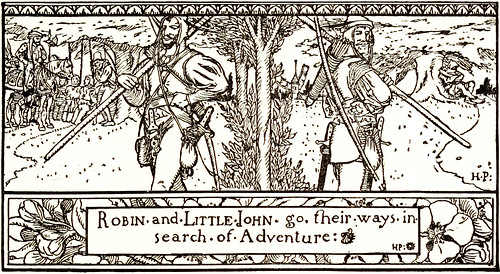
Robin Hood, the noble archer?

    I always wondered why Robin of Locksley, the son of a nobleman, would be so good with a longbow.  Ranged combat was disdained by the European knight.  He certainly didn't pick up the knack while fighting in the Crusades...  Where, then, did the character learn to wield a bow with such ability?  It is this quality, above all others, that is the centerpiece to his persona.  He may have been a fine swordsman, but it's his skill with a bow that set him apart.
https://www.flickr.com/photos/eoskins/6682273899/
    My familiarity with the Robin Hood story originates in the more kiddie friendly forms of his tales.  In the earliest references, Robin Hood is quite clearly portrayed as a yeoman.  The term "yeoman" was used to describe a variety of professions (farmers who owned their land, attendants to nobles, non-noble professional soldiers), but all of them were commoners.  One early tale names the King of Robin's time as Edward, not Richard (as is now common).  The earliest known reference to Robin is in the poem "Piers Plowman" (1377), where a character boasts familiarity with Robin's tales.  Yeah, there have been a couple of changes to the character over time.
    The early rise of the Robin stories coincides with the narrowing of the financial gap between the lesser nobility and the commoners in England during the Hundred Years War.  Various plagues, famines, and military conflicts had put a serious dent in the workforce, increasing the demand (and value) of labor.  The nobles, whose vassals had died off, couldn't very well collect taxes from them were then doubly feeling the pinch.  Nobles were also being regularly called upon to go to war on behalf of their king, which was not an inexpensive exercise (and they pass the taxes on to you, the commoners).  When economic hierarchies break down, social change is in the wind.
    Robin's portrayal as an archer is one of the few constants in all of his stories.  Even if he can be bested with a sword or quarterstaff (and he was), he had no peer with the longbow.  While archers had previously played a part on many battlefields around the world, the longbow did not come into full flower on the European battlefield until Falkirk (1298).  It became the greatest weapon the English had in their wars against the French (and English laws did as much as possible to promote archery practice among the commoners, outlawing many games that interfered with valuable practice time).  English archers were trained professionals on the battlefield, not impressed levies.  The longbow overturned traditional hierarchies on the battlefield, by dropping those big expensive armored targets (and also slaughtering pikemen) at range. Defeating a knight on horseback took either another noble knight, a rank of pikemen, or a single skilled archer.

http://blog.histouries.co.uk/2010/10/12/
a-short-history-of-the-english-longbow/

    Where the longbow came from is a bit of a mystery.  Some suggest that its design (length and materials) was adapted from the Welsh.  The longbow's greatest advantage over it's more widely used cousin, the shortbow, is in range (read: power).  Its advantage over the crossbow (or arbalest) is in rate of fire.  While its ancestry may be somewhat clouded, its effectiveness on the battlefield is unquestioned.  The English Yeomanry (in this usage, professional soldiers), employing the longbow, made a bloody mess of the opposing French Chivalry on many notable occasions.
    Utilizing the longbow as the central image for a commoner who opposes the aristocracy seems pretty damn perfect.  Long before the six-shooter became the image of the American western outlaw, the longbow was evening the odds in Sherwood Forest.  The common people were becoming educated enough to recognize that they were being taken advantage of and began to dream of ways of fighting back.  These feelings manifested in peasant revolts in both England and France on multiple occasions before the end of the Hundred Years War.  Robin's longbow most certainly played a part.


References
general - http://www.boldoutlaw.com/robages/
robin hood wiki - http://en.wikipedia.org/wiki/Robin_Hood
history channel - http://www.history.com/topics/british-history/robin-hood
yeoman wiki- http://en.wikipedia.org/wiki/Yeoman
The Art of War in the Middle Ages Oman, C.W.C. (1885)
Longbow - http://blog.histouries.co.uk/2010/10/12/a-short-history-of-the-english-longbow/


Sunday, February 22, 2015

Chivalry

I must admit that I didn't expect to be considering the finer points of chivalry while reading The Hundred Years War: A People's History, but it is probably a good point of entry (no, I haven't finished reading it yet. It was a Christmas present.  Do you know how many books I have on my "to read" list?).  Like many young people, I grew up on tales of chivalry, full of knights in armor and imperiled maidens.  We all know that period tales, and similar courtly romances, were hardly factual, but they did help to shape the image of a warrior class both to itself and those it ruled over.  Quite naturally, I'm led to wonder how historic warrior codes can be adapted and utilized in a fantasy setting.
    Chivalry is a set of ideals (though exactly which ideals were most important was largely up for interpretation by the individual).  Generally held as the highest virtue was military prowess.  If you couldn't defend your holdings, you weren't good for much.  Honor and loyalty usually came second, in terms of importance, though courtliness and piety got stuck in there as well.  
Apart from the basic level of knighthood, various orders were organized with specific goals in mind.  We all know about the Knights Templar, who started by protecting pilgrims on their way to the Holy Land.  The Knights of the Garter were formed as kind of an honor society for the knights of England, in an attempt to redefine the perception of English chivalry and tie powerful knights to the King with direct oaths of loyalty.  Knights also served as bodyguards, representatives, and advisers for their lords.


First thing first.  Why have a warrior code?

Traditional warrior codes seem to have a few basic goals.  First, they separate the warriors from the "common" people.  They aren't just farmers toting weapons.  Second, they provide a system of rules to guide soldiering as a profession, which makes its practitioners more manageable and predictable (ensuring longer lives for everyone involved, well, except for those people they kill).  It gives warriors a sense of camaraderie, which may make it easier for them to work together.

Why separate warriors from common people?

By making "warrior" a job title, and not just an as needed occupation, it increases the efficiency of these workmen (more time to hone their craft if they don't have to till the fields).

In Japan, it made the warriors solely reliant upon their respective masters for financial support, since they wouldn't deign to perform manual labor to earn money (and I seem to remember that they couldn't own land, unless elevated to lordship).  

If you want to calcify a social structure, there are few better ways than to require indoctrination to a level by a member of that level.  Every lord wants to keep their laborers laboring.  You just can't have every Joe with a knife wandering the countryside killing people (or rising up in revolt).  

Rules?  

By touting honor as one of the great virtues, you make these violence machines much less likely to hack off the hand that feeds them, or change sides for a cash incentive.

Ransoms became a convenient way for knights to turn an enemy into cash, instead of just a corpse (maybe that is what all those video games are trying to show us), plus it was a certain level of life insurance for someone whose business is death.

You reduce a fair number of variables in combat, for a commander.  "Honorable death" becomes a thing. Otherwise, you'd get a whole lot more "they ain't paying me enough for this shit," kind of response in the middle of a battle.  By tying martial prowess to social strictures, and in some cases to religion, you create not only that desired separation between classes, but also role-models to which the commoners may aspire.

Other Thoughts

Try to remember that though these men (and some women) followed a basic code, even the ones who adhered pretty strictly to it were apt to stray when a good opportunity presented itself.  They were generally not above paying off a garrison or using sneaky tricks on the battlefield.  Generally (as in baseball), it's okay to cheat, as long as you didn't get caught.  Anyway, this code was mostly used to protect members of the warrior class from other members of the same class.  Slaughtering the commoners and burning their belongings was a pretty common tactic among these "noble warriors" to goad their enemies into a fight.  


I can't say that this really brings me to any real conclusion, but it's the seed of many things.  After all, this blog isn't about giving you all the answers, but about where my head is at the moment.  See?  It's in a shambles.  Back to work.

Tuesday, February 17, 2015

Games - Shrovetide Football

Sorry I've been out of it of late.  Lots going on in life.  Just happened to notice that today is Carnival and that I had a half-finished post of exemplary relevance sitting about, waiting to be polished up.  Hope you enjoy the madness.

The Fight Between Carnival and Lent (1559) Pieter Breughel the Elder


     Shrovetide football is another local game which has been enjoyed for quite some time (Wiki says 12thC).  These historical references mention a ball game being played during Carnival, on the outskirts of London, by schoolboys and apprentices alike.  The older generation would come out and cheer on their efforts.  The rules of these specific contests don't seem to be well documented, but appear to have been going on for quite some time. Many different localized ball games have developed as regional preferences, such as enjoying more or less mayhem, shaped the games.  Some consider Shrovetide Football to be the ancestor of all modern ball games.
     The Royal Shrovetide Football Match occurs annually in Ashbourne, England (first records around 1667).  Taking place on Shrove Tuesday (in cultured places, it's Fat Tuesday) and Ash Wednesday, the "rules" seem to be mostly, stay out of the churchyard and try not to get anyone killed.  The aim is to move the cork-filled leather ball to your side's goalpost (one of two widely spaced millstones now in the middle of the river Henmore, to increase the difficulty of scoring).   Play starts each day at 2PM, and if a goal is scored before 5PM another ball is released.  Otherwise play is over for the day.  There is no limit on the numbers of players and you may use any part of the body to propel the ball.  It is played in the village, across roads, and through fields (train tunnels are also apparently fair game). These days, they board up the downtown ahead of time to avoid excessive property damage.
    It really is amazing what level of madness was permitted to occur annually as generations of Christians missed the whole point of Lent.  Just as folks glut themselves on food after a fast, any religious deprivations tend to be closely followed (or in this case, preceded) by celebrations.  Games of various sorts are a natural part of these celebration (the text mentioning the earliest ball games also mentions cock fighting), and don't forget the special sweet or savory consumables that might be available to celebrants.  Festivals often mark Saints' Days and historically important rememberances.  
    For the writer, the rollicking madness of Shrovetide Football could serve as a thoroughly entertaining backdrop for whatever your characters may be up to, whether they be new in town or just looking to settle an old score amid the madness and good-natured destruction.  Just because the setting is Medieval, doesn't mean everyone has to be glum.  Let your villagers have a little rough entertainment.

The Fight Between 
Carnival  and Lent (1559), Pieter Breughel the Elder - See more at: http://www.danceshistoricalmiscellany.com/2013/11/this-murdering-play-violent-origins-of.html#sthash.N6HcVGmV.dpuf


Ashbourne 2015 - http://www.bbc.com/news/uk-england-derbyshire-31487823
Alnwick 2015 - http://www.northumberlandgazette.co.uk/news/local-news/alnwick-shrovetide-football-match-to-honour-a-local-hero-1-7110025
"Royal"- http://news.bbc.co.uk/local/derby/hi/people_and_places/history/newsid_8494000/8494339.stm
FIFA - http://www.fifa.com/classicfootball/history/the-game/Britain-home-of-football.html
Violence during - http://www.danceshistoricalmiscellany.com/2013/11/this-murdering-play-violent-origins-of.html

Tuesday, January 27, 2015

Beekeeping

honey bee
http://www.nwibeekeepers.com/about.aspx

Humanity's relationship with the bee, and more importantly its products, has been underway since well before we started writing anything down.  Just like many other animals (bears, birds, honey badgers, and other primates), humans have long exploited the bees' honey production for cheap and tasty calories.  We also seem to have found a use or two for bees' wax along the way.  Honey bees can be found throughout the world (for the most part) and have been actively harvested by humans for quite some time.
    The first methods of honey collection, naturally, involved ransacking wild hives.  Hunter-gatherers depicted these interactions in some of their artwork.  However, the world over, we have been trying to find a better way to get along for quite some time.  Domestication has been ongoing since at least the Ancient Egyptians (ca 2422 BCE).
    We eventually figured out that through the application of smoke, calming the bees by initiating the feeding response (a resource preserving reaction to the hive potentially being destroyed by fire), bees would not sting the shit out of you.  Of course the stinging is a natural reaction for the bees, since harvesting basically entails the destruction of its home, young, food stores, and potentially the queen.
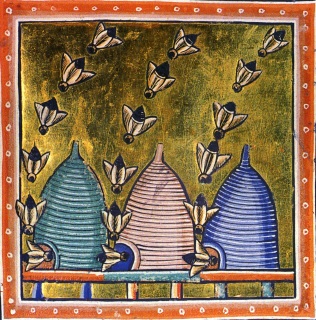
    It seems that fixed comb hives were used exclusively until the 19th Century.  This construct is almost exactly what it sounds like (except that the hives could be moved).  The hopeful beekeeper would construct a chamber amenable to occupation and lure a swarm from a natural hive (or other artificial hives) nearby.  The trouble remained that in harvesting the honey or the comb, the beekeeper would destroy the hive (it wasn't until the development of the movable frame hive that this problem was eliminated).  Hive design varied from region to region, dependent largely upon the materials at hand.
https://beeglue.wordpress.com/about-beekeeping/history-of-beekeeping/
    While harvesting required the destruction of a given hive, honey and wax production were desirable enough and low time/material investment enough to make it economically viable.  Farmers only have to invest a few hours a week to ensure production (as a bonus, bees are important pollinators).  Fixed comb hives might be constructed out of wood, clay, or plant fibers (really, anything with a cavity and an entrance).  For general production, many hives would be built close together, so that the bees would colonize multiple new hives before the original would be harvested.  Heavier clay hives would be built side by side, while wooden ones might be stacked vertically.  Plant fiber hives, or skeps, are generally light enough to be placed on shelves (outside, come on people) and have the added benefit of being easier to shape in a more natural design (relative to wooden boxes), for higher honey yields.
    A variety of commercial products are made from harvested bee colonies, including: honey, beeswax, pollen, royal jelly, and propolis.  Honey is obviously a food product by itself, but can also be used to make mead and has many medicinal applications (effective and not so much, depending on the use).  Beeswax is turned into candles, but is also an ingredient in polishes and beauty products (yeah, mustache wax).  Pollen, while perhaps the least desirable extract, can also be consumed.  Royal jelly has a grand mythology surrounding its benefits (dubious though the truth may be), enhanced by it's limited production (only really worth harvesting from the queen's cell) and shelf-life.  Propolis is what the bees use for a sealant and is the primarily employed in traditional medicines (it's also been used to bring out the wood grain in stringed instruments and for various other industrial uses).  

https://nbba.files.wordpress.com/2011/06/medieval_beekeeper_1.jpg
   
Extras
Some forms of wasp produce honey, as well, in hexagonal combs.  However, the combs are not made from wax, but from a composite of saliva and plant materials.
While ants do not make combs, some species do store honey within the bodies of some of the young workers, known as 'repletes' (who may also store water).  These repletes (with distended abdomens) hang immobile from the roof of their underground nests.  Other worker ants literally tap on these workers to have them regurgitate the stored honey.

Resources
wiki - http://en.wikipedia.org/wiki/Beekeeping
Japanese - http://warre.biobees.com/japan.htm
Swiss/German - http://www.permaculture.co.uk/readers-solutions/traditional-beekeeping-bee-hotels-switzerland-and-germany
Africa - http://teca.fao.org/technology/beekeeping-africa-traditional-and-modern-beehives-and-beekeeping-equipment-0
Malta - https://naturalbeekeeper.wordpress.com/history-of-beekeeping/beekeeping-in-malta-in-the-past/
India - http://nopr.niscair.res.in/handle/123456789/13867
Beekeeping History (book) - https://books.google.com/books?id=WVh3AAAAQBAJ&pg=PA251&lpg=PA251&dq=traditional+beekeeping+in+england&source=bl&ots=-IyKYlh9jW&sig=b2Cz3FBhkp9wC7ZvJUaDha09XVM&hl=en&sa=X&ei=sBXHVPr0NNT_yQSQqIGoDg&ved=0CDUQ6AEwBg#v=onepage&q&f=false

Friday, January 23, 2015

Creature Culture VII (trade)

Yup, I'm still working on my world (not sure when that will ever stop) and trying to figure out how these Fantasy races live with themselves.  Hmmm maybe I should clarify.  One of the things I'm trying to sus out is how to demonstrate priorities.  These other beings ain't human.  They have different drives and desires.  They may have similar failings but they manifest in different ways.
    Everyone may experience avarice, but what you desire and what I desire may be two very different things.  Some folks love fast cars, some dig the newest gadgets, others love shiny jewels.  The prices on all of these things are based upon the value that we place on them.  While I might pay $20k for a Ferrari, I'm not going to pony up full price no matter how much I could get laid driving it (plus I have a great lady, so tpbttt).  Diamonds are pretty, but really, people?  The same could very well be true between sentient species.
    Understandably, not all cultures may have developed the inclination to trade.  Humans may consider this a "higher" level of cultural development, but we're snobs that way.  Cultures may be very sophisticated, but insular.  If they are self sustaining, then why bother?  However, humans are very interested in the practice and are more than willing to introduce it to our neighbors (naturally, for our own benefit).  The trick is in figuring out what your new trading partner wants.  You can run the scenarios from there.
     The funny thing is that, while you might feel that humans are taking advantage of their "slow" neighbors, it doesn't have to be the case.  First of all, traders take all of the risk.  They transport the goods to the market, potentially over long distance, chancing misfortune along the way.  They pay in the currency the seller prefers (be it coins or cabbages).  The trader then needs to compete with other traders (via price, relationship, etc) on that market.  The producers could potentially get better prices for their goods were they market-savvy, but it ain't easy today, much less in a medieval setting (where I'm writing).
    Always remember that "The coin of the realm" may not be accepted in other realms.  I may be more interested in military alliances.  Food may be hard to come by in my land.  You might control the flow of water to my fields.  There are innumerable goods that might be more important to me than "precious" metals.  In those cases, the savvy trader might just exchange favors or friendships for goods.  Information is a product that is hard to put a price on.  Accurate maps may be highly sought after commodities.  Think about your creatures' lifestyles and basic needs.  Nomads can't portage blocks of marble everywhere.  Hammers are useless to creatures without opposable thumbs.  Oh, and my culture's interest in a specific commodity will drive up prices for everyone.
    It is an easy trap to fall into, ascribing human drives and practices to other cultures, but we don't all function the same way.  Just like we may misunderstand someone of a different culture in a social setting, we may do similar in an economic one.  The true beauty is that the traders may be thinking that each is taking advantage of the other and the truth of that belief may depend entirely upon which side you personally reside.

Friday, January 16, 2015

Tipping

Ah, a post close to the heart of every individual in a service industry.  There are many schools of thought on this practice which vary dependent on class and culture, as well as evolving over time.  I seem to remember the average dinner time gratuity rising from 10% all the way to the current 20% (then again, I remember when gas was 89cents/gallon), with a brief stopover at 18.  As a fantasy writer, should I include a tip if my characters stay at a roadside inn?
    In my "Currency" post, I discuss the use of cold hard cash in a fantasy novel.  First and foremost, if you want to have a tipping culture, it must be in a trade-rich region.  If you're leaving a tip, you must be exchanging cash for services.  Service industry workers tend to be salaried (i.e. not the owner of the business), unless they are exceptionally poor (or an apprentice).  if you're earning cash, there must be some way to pay for food and shelter near their place of work.  Not much point in having money if there is nowhere to spend it.  You can't eat it. You goddamn city slicker.  
    I just finished reading the second Scott Lynch book and the lead character leaves a rather exhorbinant tip (early on, geez I'm not spoiling anything).  It is explained to be worth half of the man's annual salary (to which is added a dozen more coins of equal value).  When figuring out what a salary should be, you might want to keep in mind that there need to be certain minimum prices for things.  While there are plenty of cultures that have cut their coins into smaller pieces to pay for little things, this is generally discouraged.  If you can pay for a meal with the smallest of coins, what would the individual elements of that meal cost at the market?  A little bit of math at the beginning can save a load of headaches later on (also remember that different countries may use different coins of different intrinsic values based upon materials).
    As I stated in the opening, waiters in the US are generally tipped 20% these days, but that is a modern convention.  The US government has helped to formalize this practice by setting a lower minimum wage for waiters and waitresses (in PA at least, if you don't equal standard minimum wage with you hourly plus tips, the restaurant makes up the difference).  People also tip hair stylists, hotel maids, and doormen (at least once a year), along with various other workers (like parking attendants, legitimate or otherwise).  In Europe, the tip is often just the change you get from the bill, even if it is just a few low denomination coins (waiters tend to make a living wage over there).  Apparently there are places where it is offensive to leave a tip, as though you think they need additional encouragement to do their job well, or their employer does not pay them enough.  For a writer, tipping traditions can be a nice point of conflict for a character traveling in a foreign land.
    It's funny, all these words spend on how to tip, and how to apply the currency properly, but very little on the "why" of it all.  Most people today are guilted into tipping.  You do it because everyone would think you were an ass if you didn't.  I like the line from "My Blue Heaven," when Vinnie says, "I don't believe in tipping.  I believe in over-tipping."  He tips to make people remember him, so that the next time he comes around they wait on him with pleasure and alacrity.  It seems a bit mercenary, but that is the point.  Tipping someone to say, "good job," is a little demeaning (in a non-tipping culture).  You tip because when you go back, you can rely on being treated better than the new faces.  It's a bribe.  Check out the origins of "gratuity."  It's always been one.  Happy tipping.

Any thoughts?  How do people tip where you are from?  Are you an over-tipper?


As an aside.  (US mainly) The next time you go out for drinks or dinner with friends and someone drops cash, be alert.  If someone puts down cash with the cards, the waiter often gets under-appreciated.  It works like this: $100 check.  $50 cash on the table.  $50 goes on a card.  The cardholder often leaves 20% of their part ($10).  Whose fault is this?  I dunno, but the server can't tell if you didn't like service, or if the table is just bad at math.  Be good to people who take care of you.


Wiki - http://en.m.wikipedia.org/wiki/Gratuity